Choosing Seat Cover Colours: Combos to Match Your Interior

A seat cover is one of the parts that covers the largest surface area in a car's interior. So the colour you choose directly changes the overall feel of the cabin. The wrong choice can make the interior look cluttered and tiring; the right combination can make the car look tidier and even more spacious. In this article we share a few simple principles to make choosing colours easier.
Start by looking at your car's existing colours
A seat cover does not exist in isolation; it is seen together with the dashboard, door panels, headliner and floor mats. Before choosing a colour, take note of the following:
- What shade are the dashboard and door panels? Black, anthracite, beige or brown?
- Is there a distinct colour in the interior's stitching, stripes or trim pieces (for example red stitching or silver trim)?
- Is the headliner light or dark?
These shades form the backdrop your cover will "tie in" with.
One base, one support, one accent
The 60-30-10 rule, often used in interior design, is a good starting point for car interiors too. According to the rule, about 60 per cent of the space is a dominant colour, 30 per cent a second colour that supports it, and 10 per cent an accent colour. Sources stress that these proportions are a guide rather than a strict rule, and that choosing a neutral shade as the dominant or secondary colour helps create a balanced look.
Here is how you can apply this to a seat cover:
- Dominant colour (leather body): A neutral shade such as black, anthracite, dark grey or brown.
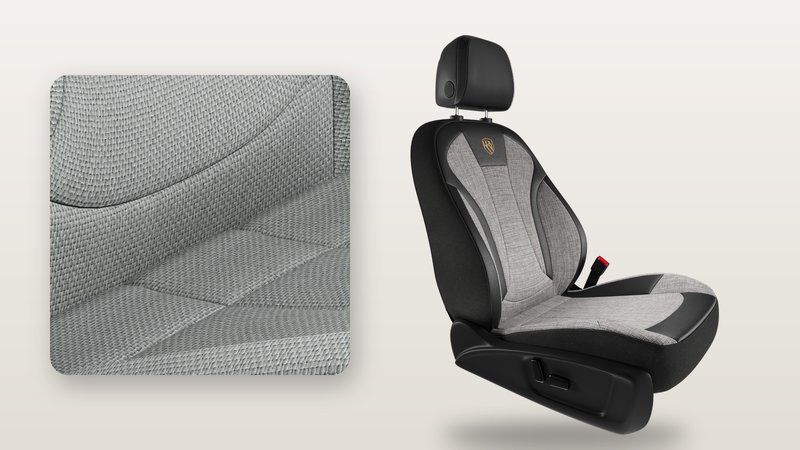
- Supporting colour (centre fabric): A colour that goes with the body but is a shade or two different; for example grey linen with black leather, or beige Babyface with brown leather.
- Accent colour (piping, Lacoste fabric or stitching): A single bright colour used in small areas, such as red, orange, blue or tan.
Stick to one accent colour
The most common mistake is using more than one bright colour on the same cover. When red piping, blue Lacoste fabric and yellow stitching come together, the eye does not know where to look. Choosing a single accent colour and repeating it in a few places gives a calmer, more deliberate look. If your car's interior already has an accent colour (for example the red stitching in sport packages), using the same colour on the cover creates a cohesive whole.
Sample combinations
Simple and timeless
- Black leather body, anthracite linen centre, black Lacoste fabric edges. Suits almost any interior.
Warm and classic
- Brown leather body, beige jacquard centre, brown piping. The jacquard texture of the Asaf Series suits this style.
Sporty
- Black leather body, black embroidered Babyface centre, red Lacoste fabric or piping details. The Sport Line Series is a good example of this approach.
Light and airy
- Grey leather body, light grey linen centre, white or light grey piping. Can make the cabin feel bigger in small cars.
Pattern and texture matter as much as colour
Colour alone does not tell the whole story. Textured surfaces such as the honeycomb-patterned Rumi Series or the Liva Series with its pyramid Lacoste fabric create depth even in a single-colour combination. If you have chosen a patterned fabric, reducing the number of colours gives a balanced result; if you have chosen a plain fabric, playing with texture does the same.
How much does the car's exterior colour matter?
When the door opens, the exterior colour and the interior are seen at the same time, so creating a link between the two can give a pleasing sense of unity. For example, navy or blue-toned piping in a navy car, or red stitching or Lacoste fabric details in a red car, make a subtle reference. However, carrying the exterior colour onto the large surfaces of the seat often looks too bold. Using the exterior colour only as an accent, that is, in the 10 per cent portion, gives a more balanced result.
Practical considerations
- Light colours show stains more quickly. For families with children or people who travel with pets, mid tones can be more practical.
- Dark colours absorb more heat in the sun. Cars already get very hot in the sun; in a study carried out in Arizona, the seat surface in cars left in the sun for one hour reached an average of about 51 °C. If you live in a hot region, you may prefer a lighter shade for the centre fabric.
- Dust and hair: Black fabric shows light-coloured hair more clearly, while light fabric shows dark hair more.
Trying it out with Design Your Own
On the Design Your Own page you can choose the colour of each part separately, such as the leather, fabric, Lacoste fabric and piping. Since there are tens of thousands of possible combinations, seeing a few options side by side before deciding makes things easier. A good order is to choose the neutral body colour first, then the centre fabric, and the accent colour last. Since screen colours can look slightly different from device to device, we recommend asking us about the real colour of the fabric for any shades you are undecided about.
Final word
A good colour combination is usually a simple one: a neutral base, a harmonious supporting colour and a single accent. If you send us the combination you have designed via WhatsApp, we can tell you whether it suits your car and how much it costs.