Car Seat Cover Fabrics: Which One Is Right for You?

When choosing a seat cover, most people look at the colour first. Yet what you actually touch every day in your car is the fabric itself: how much does it make you sweat in summer, how cold does it feel in winter, how easily does the juice your kids spill come out? In this guide we go through the main materials we use in our covers one by one and explain, in plain language, which one suits which kind of use.
What to look for when assessing a fabric
Rather than labelling a fabric simply "good" or "bad", it is more useful to think in terms of a few criteria:
- Abrasion resistance: In the Martindale test, widely used for upholstery fabrics, the fabric is rubbed in a circular motion under a weight and the number of cycles until visible wear appears is recorded. In the furniture industry, 25,000-30,000 cycles is considered the benchmark for heavy domestic use, and 30,000 and above for commercial use.
- Breathability: Directly affects comfort on long journeys and in hot weather.
- Ease of cleaning: Is it a wipe-clean surface, or a texture that needs brushing and a damp cloth?
- Feel and warmth: Is it cold when you first get in on a winter morning, or soft and warm?
Leather and leather-look materials
We use leather-look material on the main body sections of our covers. Coated fabrics of this kind are usually made by applying a polyurethane (PU) or PVC layer to a textile backing. According to industry sources, PU is the option that most closely resembles real leather in feel and in the way it drapes, while PVC offers a surface that is more resistant to moisture.
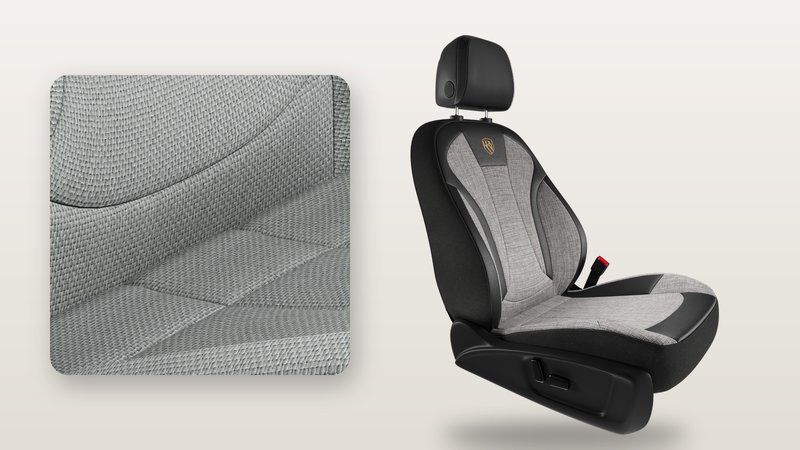
The biggest advantage of a leather-look surface is that it wipes clean. A spilled drink, dust or pet hair comes off easily with a damp cloth. The downside is that the surface heats up and does not breathe when the car is left in the sun in summer. That is why many of our models use leather on the sides and edges and a breathable fabric in the centre of the seating surface.
Linen
Linen is a natural fibre obtained from the flax plant. According to studies compiled by the European flax and hemp confederation, linen is the most permeable to water vapour of the fibres tested, and it absorbs moisture quickly and spreads it over a wide area. This helps keep the seating surface drier in hot weather. The same source also notes that linen retains heat better than viscose and cotton, so linen is not only a summer fabric. Being a natural fibre, it develops a slight texture with use, which is part of the material's character. The Babil Series and the honeycomb-patterned Rumi Series are among our models with a linen centre.
Babyface and embroidered Babyface
Babyface is a fabric with a short, dense pile and a soft touch. Because it does not feel cold on first contact, it is especially popular in the winter months. In the embroidered version, a stitched pattern is worked into the fabric; this adds depth to the look and helps the fabric sit more neatly on the seat. The Hüma Series uses plain Babyface, while the Sport Line Series uses embroidered Babyface. The pile surface holds dust and pet hair a little more than smooth surfaces do, but regular vacuuming keeps this easily under control.
Lacoste fabric
Lacoste fabric, known in textile terminology as piqué, is a knitted fabric whose surface is made up of small honeycomb cells or raised dots. It takes its name from the brand that used this texture on its polo shirts. The raised structure creates small air pockets and helps the fabric hold its shape better than a plain knit. We mostly use Lacoste fabric on edges and transition panels, while in the Liva Series a pyramid-patterned Lacoste fabric takes centre stage.
Jacquard fabric
In jacquard fabric the pattern is not printed on afterwards; it is woven into the fabric by raising and lowering the threads during weaving. As a result, the pattern does not sit on the surface like a printed layer but is part of the fabric's structure. Because the weave is tight, it is a frequent choice for upholstery. Even so, durability depends not only on the weaving technique but also on the yarn used. The Asaf Series, with its jacquard centre fabric, was created for those looking for a classic look.
Air File
Air File is a breathable fabric produced with an open-knit structure to increase airflow. In the Air File Taç model, this fabric is combined with an embroidered Babyface centre and Lacoste fabric edges; the aim is to reduce sweating in summer while keeping a soft touch.
Quick comparison
- Easiest to wipe clean: Leather-look surfaces.
- For summer: Linen and Air File.
- For winter: Babyface and embroidered Babyface.
- For a patterned, classic look: Jacquard fabric.
- For textured, sporty edges: Lacoste fabric.
Why are mixed materials so common?
No single material can do everything best. That is why most of our covers have leather on the sides of the seat, which are most exposed to wear and dirt, and a breathable or soft fabric in the centre of the backrest and seating surface. This way, easy cleaning and comfort come together in the same cover.
This approach has another benefit: the part of a cover that wears fastest is usually the side bolster on the door side of the driver's seat. Every time you get in, your leg, the seat belt buckle and your clothes rub against this area. Using a wipe-clean, abrasion-resistant surface here helps the fabric in the centre keep its as-new look for longer.
Questions to ask yourself when choosing
- Is the car mostly parked in the sun or in a covered car park?
- Do you carry children or pets in the back seat?
- How many hours a day do you spend in the car; short city trips or long journeys?
- How cold does your car get in winter, and does it have seat heating?
The answers to these questions often settle the choice by themselves: linen or Air File for hot regions and long journeys, Babyface for cold climates, and a design with a high proportion of leather for heavy family use.
Final word
Your usage habits are the best guide to which fabric suits you: where you park, how long you spend on the road, who sits in the back. If you are undecided, you can put fabric samples and colour options together on the Design Your Own page and send them to us via WhatsApp, and ask any questions you have the same way.